

Since launching my coaching practice, I’ve gotten a lot of questions about the name. Usually, right after: so, what is coaching, anyway? Let me take a crack at answering both.
It all starts with two very different experiences of being coached.
About eight years into my career, I decided it was a good time to go to business school. As I mentioned in previous essays, I had a sense that the path I was on didn’t quite match who I wanted to be, but I didn’t have any better alternatives in mind. Maybe the answers could be found at UC Berkeley. After all, there were plenty of other folks there searching for their North Star.
My first experience with coaching there was well-intentioned but mostly transactional: What role are you targeting? What’s your timeline? Let’s build an action plan. That’s all helpful… if you already know what you want. But I didn’t. I was in the fog. And no amount of goal-setting was going to cut through it, because the issue wasn’t a lack of planning or execution. It was that I genuinely didn’t know what I wanted.
Not ready to give up on the idea, I tried coaching again a few months later. The experience was nothing like the first. This new coach wasn’t interested in my five-year plan. She asked a completely different kind of question. Not what job do you want? but what’s true about you that you’re not seeing?
That opened up something I wasn’t expecting. I started to see qualities in myself — humor, relatability, the ability to hold complexity and sit with people in hard moments — that had always been there but never felt like they “counted.” They don’t show up on a résumé. They weren’t part of any performance review. But they’re central to who I am and what matters to me. I just hadn’t had the space, or the permission, to take them seriously.
Something shifted. Not because a coach gave me the answers, but because they created the conditions for me to find and trust my own.
That’s what coaching is, at its best. And it’s very different from most of the guidance that’s available to us in our careers.
Career advice, mentorship, strategic planning… They’re useful, but they tend to share an assumption: that you already know what you want, and just need help getting there. Most of the people I encountered at KPMG were already incredibly capable when it came to executing plans, hitting targets, and delivering results. And there was no shortage of guidance on the performance side.
The formal career and performance support is valuable for what it is. But it doesn’t leave a lot of room for the harder questions. The ones that sound like: What if the promotion I earned didn’t bring pride or excitement — just relief for not coming up short? What if the path I’m on isn’t the right one, and what I want isn’t actually here?
If you’ve had some version of those questions running in the background, you already know they don’t fit neatly into a development plan or a performance review. And you probably also know that ignoring them doesn’t make them quieter.
The hard part is that there aren’t many places to take them. Your boss has their own incentives: they may care about you, but they also need you performing. Your friends and family want what’s best for you, but they may not know your professional world well enough to sit with the complexity, or they’re so invested in your stability that the questions themselves feel threatening. So the harder questions tend to stay internal, circling without anywhere to land.
Coaching at its most powerful meets you in that messy middle, where the deeper questions live. In that stretch where something is stirring but hasn’t taken shape. Where the honest answer is I’m not sure anymore. That’s not a problem to solve. It’s the starting point.
As a coach, I’m not here to fix people who think they’re broken. I’m here to create space for people who sense something’s off but don’t yet have the language to trust that sensing. If that’s you, the starting point isn’t a plan. It’s permission to take what you’re noticing seriously.
So what does it actually look like?
If anything I’ve described sounds familiar (the circling questions, the gap between what’s expected and what’s true), here’s what it looks like to actually work on it.
It starts with a real, honest, and sometimes uncomfortable conversation. We begin with whatever is most alive for you. Maybe it’s a decision you’re sitting with. Maybe it’s a restlessness you can’t shake, or a creeping sense that the life you’ve built doesn’t quite fit the person you’re becoming. You don’t need to arrive with a clear summary or neatly-defined issue. Most people don’t.
From there, I ask questions. Not to interrogate, but to help you hear yourself more clearly. The patterns you’ve been running on autopilot. The stories you’ve absorbed about what a “good career” or a “responsible life” is supposed to look like. The thing you keep circling back to that you haven’t let yourself take seriously. My job isn’t to tell you what to do. It’s to help you notice what’s already true and decide what you want to do about it.
Over time, that noticing turns into movement. Together, we design real practices and experiments that you take into your life between sessions to try out the shifts that matter to you. And afterward, we reflect on what happened, draw out the insights, and adjust accordingly. It’s not about a single breakthrough. It’s about developing something authentic that sticks, so that you keep choosing well long after our work together is done.
People don’t usually need someone to hand them the answers. They need someone to help them slow down long enough to hear the ones they already have.
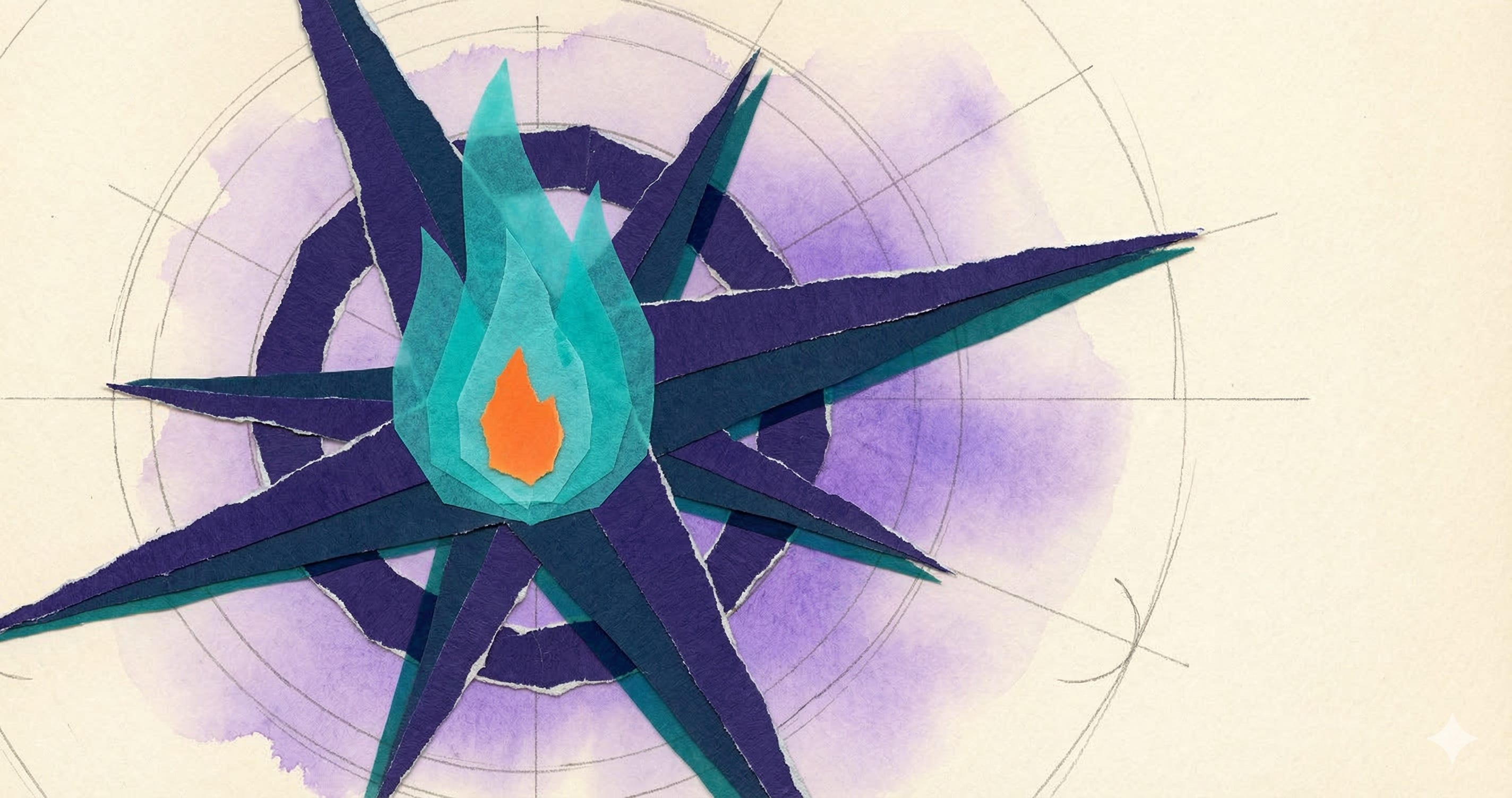
And that distinction — the difference between being handed a roadmap to someone else’s destination and learning to follow your own sense of direction — is the reason my practice is called Compass & Flame.
The compass is your sense of direction: the values you keep returning to, the impact you want to have, the underlying knowing that something needs to change even when you can’t explain why. You might not trust it yet. It might be buried under years of doing what you thought you were supposed to do. But it’s already there.
The flame is the energy and aliveness that show up when you’re working and living in a way that feels genuinely yours. When there’s authenticity and vitality in what you’re doing, not just competence.
When both are present, when your work reflects what you care about and makes you come alive, that’s the sweet spot. Coaching, the way I practice it, is about helping you reconnect with both your compass and your flame, and building a next chapter that honors both.
Trust your direction. Commit to what matters.
If something here hit close to home, I’d love to hear from you — whether that’s a reply to this email, a note to will.oldfather@compassandflame.com, or a Discovery Call to talk about what you’re navigating.
No pressure, no pitch. Just a real conversation